
我们知道Java语言对于多线程的支持十分丰富,JDK本身提供了很多性能优良的库,包括ThreadPoolExecutor和ScheduleThreadPoolExecutor等。C++11中的STL也提供了std:thread(然而我还没有看,这里先占个坑)还有很多第三方库的实现。这里我重复“造轮子”的目的还是为了深入理解C++和Linux线程基础概念,主要以学习的目的。
首先,为什么要使用线程池。因为线程的创建、和清理都是需要耗费系统资源的。我们知道Linux中线程实际上是由轻量级进程实现的,相对于纯理论上的线程这个开销还是有的。假设某个线程的创建、运行和销毁的时间分别为T1、T2、T3,当T1+T3的时间相对于T2不可忽略时,线程池的就有必要引入了,尤其是处理数百万级的高并发处理时。线程池提升了多线程程序的性能,因为线程池里面的线程都是现成的而且能够重复使用,我们不需要临时创建大量线程,然后在任务结束时又销毁大量线程。一个理想的线程池能够合理地动态调节池内线程数量,既不会因为线程过少而导致大量任务堆积,也不会因为线程过多了而增加额外的系统开销。
其实线程池的原理非常简单,它就是一个非常典型的生产者消费者同步问题。根据刚才描述的线程池的功能,可以看出线程池至少有两个主要动作,一个是主程序不定时地向线程池添加任务,另一个是线程池里的线程领取任务去执行。且不论任务和执行任务是个什么概念,但是一个任务肯定只能分配给一个线程执行。这样就可以简单猜想线程池的一种可能的架构了:主程序执行入队操作,把任务添加到一个队列里面;池子里的多个工作线程共同对这个队列试图执行出队操作,这里要保证同一时刻只有一个线程出队成功,抢夺到这个任务,其他线程继续共同试图出队抢夺下一个任务。所以在实现线程池之前,我们需要一个队列。这里的生产者就是主程序,生产任务(增加任务),消费者就是工作线程,消费任务(执行、减少任务)。因为这里涉及到多个线程同时访问一个队列的问题,所以我们需要互斥锁来保护队列,同时还需要条件变量来处理主线程通知任务到达、工作线程抢夺任务的问题。
一般来说实现一个线程池主要包括以下4个组成部分:
- 线程管理器:用于创建并管理线程池。
- 工作线程:线程池中实际执行任务的线程。在初始化线程时会预先创建好固定数目的线程在池中,这些初始化的线程一般处于空闲状态。
- 任务接口:每个任务必须实现的接口。当线程池的任务队列中有可执行任务时,被空间的工作线程调去执行(线程的闲与忙的状态是通过互斥量实现的),把任务抽象出来形成一个接口,可以做到线程池与具体的任务无关。
- 任务队列:用来存放没有处理的任务。提供一种缓冲机制。实现这种结构有很多方法,常用的有队列和链表结构。
流程图如下:
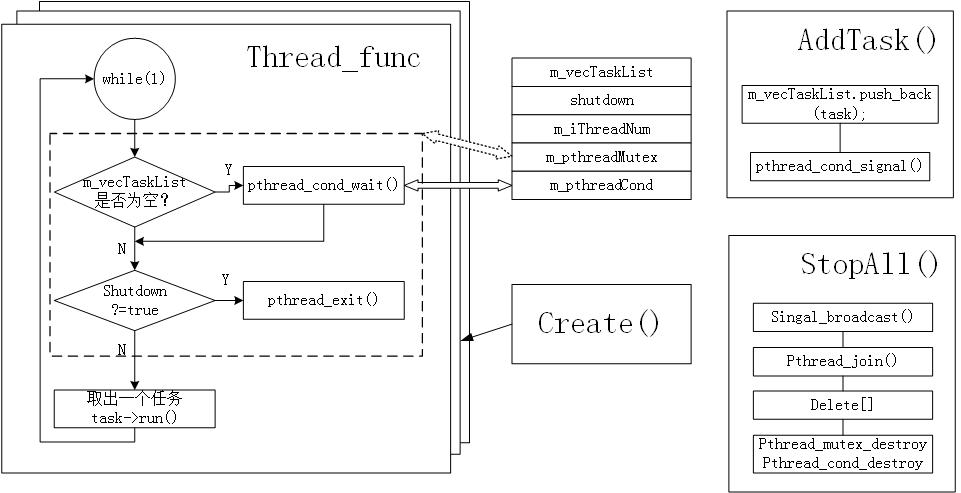
ool.h
-
#ifndef __THREAD_POOL_H -
#define __THREAD_POOL_H -
#include <vector> -
#include <string> -
#include <pthread.h> -
using namespace std; -
/*执行任务的类:设置任务数据并执行*/ -
class CTask { -
protected: -
string m_strTaskName; //任务的名称 -
void* m_ptrData; //要执行的任务的具体数据 -
public: -
CTask() = default; -
CTask(string &taskName): m_strTaskName(taskName), m_ptrData(NULL) {} -
virtual int Run() = 0; -
void setData(void* data); //设置任务数据 -
virtual ~CTask() {} -
}; -
/*线程池管理类*/ -
class CThreadPool { -
private: -
static vector<CTask*> m_vecTaskList; //任务列表 -
static bool shutdown; //线程退出标志 -
int m_iThreadNum; //线程池中启动的线程数 -
pthread_t *pthread_id; -
static pthread_mutex_t m_pthreadMutex; //线程同步锁 -
static pthread_cond_t m_pthreadCond; //线程同步条件变量 -
protected: -
static void* ThreadFunc(void *threadData); //新线程的线程回调函数 -
static int MoveToIdle(pthread_t tid); //线程执行结束后,把自己放入空闲线程中 -
static int MoveToBusy(pthread_t tid); //移入到忙碌线程中去 -
int Create(); //创建线程池中的线程 -
public: -
CThreadPool(int threadNum); -
int AddTask(CTask *task); //把任务添加到任务队列中 -
int StopAll(); //使线程池中的所有线程退出 -
int getTaskSize(); //获取当前任务队列中的任务数 -
}; -
#endif
2 thread_pool.cpp
-
#include "thread_pool.h" -
#include <cstdio> -
void CTask::setData(void* data) { -
m_ptrData = data; -
} -
//静态成员初始化 -
vector<CTask*> CThreadPool::m_vecTaskList; -
bool CThreadPool::shutdown = false; -
pthread_mutex_t CThreadPool::m_pthreadMutex = PTHREAD_MUTEX_INITIALIZER; -
pthread_cond_t CThreadPool::m_pthreadCond = PTHREAD_COND_INITIALIZER; -
//线程管理类构造函数 -
CThreadPool::CThreadPool(int threadNum) { -
this->m_iThreadNum = threadNum; -
printf("I will create %d threads.\n", threadNum); -
Create(); -
} -
//线程回调函数 -
void* CThreadPool::ThreadFunc(void* threadData) { -
pthread_t tid = pthread_self(); -
while(1) -
{ -
pthread_mutex_lock(&m_pthreadMutex); -
//如果队列为空,等待新任务进入任务队列 -
while(m_vecTaskList.size() == 0 && !shutdown) -
pthread_cond_wait(&m_pthreadCond, &m_pthreadMutex); -
//关闭线程 -
if(shutdown) -
{ -
pthread_mutex_unlock(&m_pthreadMutex); -
printf("[tid: %lu]\texit\n", pthread_self()); -
pthread_exit(NULL); -
} -
printf("[tid: %lu]\trun: ", tid); -
vector<CTask*>::iterator iter = m_vecTaskList.begin(); -
//取出一个任务并处理之 -
CTask* task = *iter; -
if(iter != m_vecTaskList.end()) -
{ -
task = *iter; -
m_vecTaskList.erase(iter); -
} -
pthread_mutex_unlock(&m_pthreadMutex); -
task->Run(); //执行任务 -
printf("[tid: %lu]\tidle\n", tid); -
} -
return (void*)0; -
} -
//往任务队列里添加任务并发出线程同步信号 -
int CThreadPool::AddTask(CTask *task) { -
pthread_mutex_lock(&m_pthreadMutex); -
m_vecTaskList.push_back(task); -
pthread_mutex_unlock(&m_pthreadMutex); -
pthread_cond_signal(&m_pthreadCond); -
return 0; -
} -
//创建线程 -
int CThreadPool::Create() { -
pthread_id = new pthread_t[m_iThreadNum]; -
for(int i = 0; i < m_iThreadNum; i++) -
pthread_create(&pthread_id[i], NULL, ThreadFunc, NULL); -
return 0; -
} -
//停止所有线程 -
int CThreadPool::StopAll() { -
//避免重复调用 -
if(shutdown) -
return -1; -
printf("Now I will end all threads!\n\n"); -
//唤醒所有等待进程,线程池也要销毁了 -
shutdown = true; -
pthread_cond_broadcast(&m_pthreadCond); -
//清楚僵尸 -
for(int i = 0; i < m_iThreadNum; i++) -
pthread_join(pthread_id[i], NULL); -
delete[] pthread_id; -
pthread_id = NULL; -
//销毁互斥量和条件变量 -
pthread_mutex_destroy(&m_pthreadMutex); -
pthread_cond_destroy(&m_pthreadCond); -
return 0; -
} -
//获取当前队列中的任务数 -
int CThreadPool::getTaskSize() { -
return m_vecTaskList.size(); -
}
3 main.cpp
-
#include "thread_pool.h" -
#include <cstdio> -
#include <stdlib.h> -
#include <unistd.h> -
class CMyTask: public CTask { -
public: -
CMyTask() = default; -
int Run() { -
printf("%s\n", (char*)m_ptrData); -
int x = rand()%4 + 1; -
sleep(x); -
return 0; -
} -
~CMyTask() {} -
}; -
int main() { -
CMyTask taskObj; -
char szTmp[] = "hello!"; -
taskObj.setData((void*)szTmp); -
CThreadPool threadpool(5); //线程池大小为5 -
for(int i = 0; i < 10; i++) -
threadpool.AddTask(&taskObj); -
while(1) { -
printf("There are still %d tasks need to handle\n", threadpool.getTaskSize()); -
//任务队列已没有任务了 -
if(threadpool.getTaskSize()==0) { -
//清除线程池 -
if(threadpool.StopAll() == -1) { -
printf("Thread pool clear, exit.\n"); -
exit(0); -
} -
} -
sleep(2); -
printf("2 seconds later...\n"); -
} -
return 0; -
}
4 Makefile
-
CC:= g++ -
TARGET:= threadpool -
INCLUDE:= -I./ -
LIBS:= -lpthread -
# C++语言编译参数 -
CXXFLAGS:= -std=c++11 -g -Wall -D_REENTRANT -
# C预处理参数 -
# CPPFLAGS:= -
OBJECTS :=thread_pool.o main.o -
$(TARGET): $(OBJECTS) -
$(CC) -o $(TARGET) $(OBJECTS) $(LIBS) -
# $@表示所有目标集 -
%.o:%.cpp -
$(CC) -c $(CXXFLAGS) $(INCLUDE) $< -o $@ -
.PHONY : clean -
clean: -
-rm -f $(OBJECTS) $(TARGET)
5 输出结果
-
I will create 5 threads. -
There are still 10 tasks need to handle -
[tid: 140056759576320] run: hello! -
[tid: 140056751183616] run: hello! -
[tid: 140056742790912] run: hello! -
[tid: 140056734398208] run: hello! -
[tid: 140056767969024] run: hello! -
2 seconds later... -
There are still 5 tasks need to handle -
[tid: 140056742790912] idle -
[tid: 140056742790912] run: hello! -
[tid: 140056767969024] idle -
[tid: 140056767969024] run: hello! -
[tid: 140056751183616] idle -
[tid: 140056751183616] run: hello! -
[tid: 140056759576320] idle -
[tid: 140056759576320] run: hello! -
[tid: 140056751183616] idle -
[tid: 140056751183616] run: hello! -
[tid: 140056734398208] idle -
2 seconds later... -
There are still 0 tasks need to handle -
Now I will end all threads! -
2 seconds later... -
[tid: 140056734398208] exit -
[tid: 140056767969024] idle -
[tid: 140056767969024] exit -
[tid: 140056759576320] idle -
[tid: 140056759576320] exit -
[tid: 140056751183616] idle -
[tid: 140056751183616] exit -
[tid: 140056742790912] idle -
[tid: 140056742790912] exit -
2 seconds later... -
There are still 0 tasks need to handle -
Thread pool clear, exit.
扩展资料:
线程池设计中的惊群问题
C 实现有追求的线程池 探究
高效线程池(threadpool)的实现
转载于:https://www.cnblogs.com/alwayswangzi/p/7138154.html
相关资源:C++线程池实例
(3条消息) 基于Linux/C++简单线程池的实现_weixin_30457881的博客-CSDN博客